
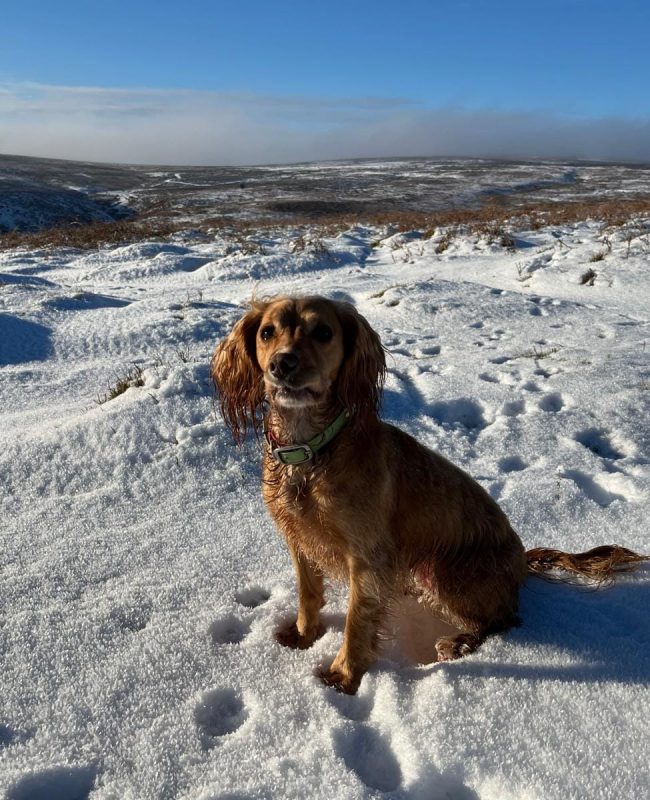
Myrtle is a 5-year-old lemon Working Cocker Spaniel looking for a very special home.
- Status: Available
- Breed: Working Cocker
- Age: 5
- Location: Shropshire SY3
- Foster or adopt: Adopt
- Vaccinated: Yes
- Neutered:Yes
- Tail: Full
- OK with dogs: No
- OK with cats: Unknown
- OK with children: 12+
- Separation anxiety: No
- Basic commands: Some
- Must be an only dog: Yes
- Housetrained:Yes
- Crate trained: Yes
- Health issues: No
- Needs an experienced owner: Yes
- Adoption fee: £350
However, her current family have found that the move from a rural environment to a town, combined with busy working lives and the arrival of their baby, has made it increasingly difficult to give Myrtle the lifestyle and consistency she needs.
They want nothing more than for her to be happy, stimulated and loved, and are looking for the right home rather than simply the quickest home.
What Myrtle needs
Myrtle needs a very experienced home, ideally with someone who understands working Cockers and is genuinely interested in giving her opportunities to use both her body and her brain.
Her ideal home would be:
- Rural or semi-rural
- Have a secure garden
- Have good access to fields, woodland, countryside or other suitable walking areas
- Be away from busy urban environments and regular close-proximity traffic
- Have active owners who enjoy getting out and about
- Be willing to continue her training
- Be interested in activities such as scentwork, trailing, gundog activities or other appropriate brainwork
Myrtle is not suited to town or urban living. Busy streets, pavements, outdoor cafés and similar environments can leave her worried and overstimulated. She isn’t generally reactive to traffic or other people, but being in close proximity to traffic and busy environments makes it much harder for her to settle and can cause her to pull, weave and become unsettled.
For this reason, the environment she lives in will be extremely important to her success.
Myrtle’s ideal lifestyle
Take Myrtle somewhere she can run, explore and use her brain and you see a very different dog.
She loves beaches, water, fields and woodland, and is much happier when she can have appropriate off-lead exercise in suitable areas.
Her recall is excellent. She can run a considerable distance ahead and will reliably return when called, and she responds very well to her whistle.
She also regularly walks with dog walkers and is accustomed to travelling in a van and walking with groups of dogs.
She enjoys running with her family using a waist belt and bungee lead attached to a harness.
The biggest challenge is not her ability to exercise — it is getting her comfortably from A to B in environments that she finds overwhelming.
Lead walking
Myrtle’s lead walking is currently her biggest area for improvement.
She pulls hard, can weave from side to side and will sometimes walk behind her handler. This becomes particularly difficult in busy environments where she is already overstimulated.
Her owners recognise this themselves and have worked hard on it with her. Myrtle has received training from several trainers, including a residential gundog trainer, but her family feel that they have not always been able to maintain the consistency required afterwards, and the pulling has therefore returned.
In a suitable rural or semi-rural home, where she does not need to negotiate busy roads and pavements regularly, we believe this would be much easier to manage while continuing to work on her skills.
A very clever girl
Myrtle is an extremely quick learner and loves having something to do.
She can sometimes be very lively in the house and find it difficult to switch off. She is a working-line Cocker and needs more than simply physical exercise.
We feel that introducing regular scentwork, treat searches, trailing and other appropriate brainwork could be hugely beneficial for her and help her learn to settle after mentally tiring activities.
She is not destructive in the garden and generally entertains herself, although she may occasionally dig a hole if she discovers something particularly interesting!
At home she has access to a quiet pantry which she can choose to use when she wants some peace and time away from everyone. Her new home should continue to provide Myrtle with this kind of safe, quiet space where she can choose to settle.
Other dogs
Myrtle is generally good with other dogs and has regular experience walking alongside them. Her dog walkers have not reported any concerning behaviour.
She is, however, fairly indifferent to other dogs when out and tends to be much more focused on her people and what she is doing.
If a particularly lively or larger dog rushes towards her, she can become unsure and may grumble or chase the dog away. There has been no snapping or biting.
Her owners have noticed that this behaviour became more apparent around the time Beth was pregnant and after their baby arrived. They have worked hard on this with Myrtle, teaching her to sit and stay beside them, and report that this has improved considerably.
There have also been some issues when other dogs come into the home. Myrtle can become worried if dogs are simply brought straight inside and may guard toys in that situation. She can also guard food and treats around other dogs, although she has no problem whatsoever with people taking food or treats from her.
We believe these situations can be managed carefully, including by introducing dogs outside the home first and taking a sensible, gradual approach.
Because Myrtle is not particularly interested in canine companionship, we feel she would probably benefit from being the only dog in the home, although this will be considered on an individual basis.
Children
Myrtle currently lives with a baby and was described during her assessment as being wonderful with the baby.
She was happy to sit nose-to-nose with the baby while they crawled and began pulling themselves up, and she gently took food from the baby’s fingers.
She is regularly around children and older people and is friendly and affectionate with people.
However, Myrtle is a very active dog and can become extremely lively when excited, particularly when playing with a ball. There is therefore the potential for her to accidentally knock a small child over.
Any home with children would need to understand her energy levels and manage interactions appropriately.
At home
Myrtle is housetrained and can be left for four hours or more without difficulty.
She does not use a crate. Instead, she has access to a quiet room where she can take herself away when she wants some peace. We would encourage her new family to continue providing her with this option.
She can be lively in the home and sometimes struggles to switch off, but we believe appropriate mental stimulation and scent-based activities could make a significant difference.
She is affectionate and enjoys being close to her people. She can sometimes be a little over-enthusiastic about where she chooses to sit, but this is simply an area where clear boundaries and positive alternatives can be established.
Travelling and everyday life
Myrtle travels very well in the car and is accustomed to travelling to places where she can enjoy better walks.
She has no problems with general household noises, thunder or traffic noise from inside the home. It is close proximity to traffic when out walking that causes her difficulty.
She is also comfortable being groomed and is generally good at the vets.
Finding the right home for Myrtle
Myrtle’s family love her enormously. They have had her since she was a puppy and have put a great deal of work into understanding and training her.
They recognise that her current lifestyle is no longer allowing her to thrive, particularly because of the combination of town living, busy roads, work commitments and the demands of having a young child.
They are not looking to rush her into another home. Ideally they would like her settled before Stephen starts his new job in September, but finding the right home is much more important than a deadline.
They also want to avoid Myrtle going into kennels or moving into a foster home only to be uprooted again when she is subsequently adopted.
Their preference is therefore for Myrtle to move directly from her family into the right permanent home, wherever possible, allowing her to have the most settled transition.
Our approach to finding Myrtle’s match
One of our behaviourists has been working with Myrtle and her owners and has a good understanding of her needs.
Our behaviourist will be involved in reviewing applications alongside us to help make sure we find the right match for Myrtle.
This means we will be looking particularly carefully at the environment, lifestyle and experience of potential adopters.
Myrtle is not suitable for an urban home, and we are looking for people who genuinely understand working Cocker Spaniels and are prepared to continue her training and provide her with the physical and mental stimulation she needs.
We are not simply looking for someone who can give Myrtle a lot of exercise. We are looking for someone who will give her the right kind of life.
Myrtle is an incredibly bright, loving and trainable girl with so much to offer. With the right environment, experienced owners and plenty of opportunities to work her brain as well as her body, we believe she can really flourish.
If you think you may be the right home for Myrtle, please read her requirements carefully before applying. We are looking for the right home for Myrtle — not simply any home.